
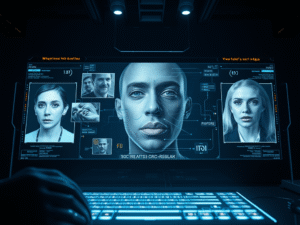
Introduction to Deepfake Technology
Deepfake Technology. Imagine watching a video of a famous actor promoting a product he never endorsed, or a political leader giving a speech that never actually happened. At first glance, everything looks real—the voice, the expressions, even the background. But in reality, it’s all generated by artificial intelligence. That’s the world of Deepfake Technology.
Deepfakes are reshaping how we look at truth in digital media. From funny celebrity mashups and entertainment to dangerous misinformation, this technology is powerful, fascinating, and controversial at the same time. In simple words, it’s like Photoshop for videos, but on a whole new level.
Definition and Overview
Deepfake Technology refers to the use of AI to create realistic images, audio, or videos of people doing or saying things that never happened. It combines the words “deep learning” (AI models) and “fake” (altered or fabricated content).
Unlike traditional video editing, deepfakes don’t just cut and paste. They use advanced algorithms to study facial movements, speech patterns, and even micro-expressions to generate highly convincing results.
At its core, deepfake technology is about synthetic media—content made or modified by AI. While it can be used for creative purposes like movies and art, it also raises serious concerns about trust, ethics, and online safety.
Historical Context and Evolution
The journey of deepfakes started in 2017 when AI hobbyists began experimenting with open-source tools to swap celebrity faces in videos. At first, results looked funny but glitchy. Within a few years, however, the quality improved dramatically, thanks to Generative Adversarial Networks (GANs) and other deep learning methods.
Soon, deepfake clips went viral on social media, sparking debates about their potential. By the 2020s, industries like film, advertising, and gaming started using this technology for positive use cases—like recreating historical figures or de-aging actors in movies.
Today, deepfakes have become so realistic that sometimes even experts struggle to tell the difference. This rapid growth shows both the creativity and risks of AI-powered media.
How Deepfake Technology Works
Key Technologies
1. Generative Adversarial Networks (GANs) – Two AI models compete with each other: one creates fake content, the other checks for errors, making the result more realistic over time.
2. Autoencoders – Neural networks that compress facial features and reconstruct them onto another face.
3. Natural Language Processing (NLP) – Used in voice-based deepfakes to mimic speech patterns and intonations.
Training Process
Deepfake AI models are trained on large datasets of photos, videos, and audio recordings. The more data available, the better the system can capture facial movements, expressions, and voices.
For example, if an AI is trained on thousands of clips of a celebrity speaking, it can later generate new footage where the celebrity says things they never actually said—complete with natural lip-syncing and expressions.
Types of Deepfakes
1. Face Swaps – Replacing one person’s face with another in a video.
2. Lip-Sync Deepfakes – Altering someone’s lip movements to match new audio.
3. Voice Deepfakes – Cloning a person’s voice to generate realistic speech.
4. Full-Body Deepfakes – Advanced models that replicate body movements and gestures.
Applications of Deepfake Technology
Entertainment and Movies
Hollywood uses deepfakes to de-age actors, bring back late performers, or create realistic stunt doubles. For example, some blockbuster movies have already used AI to recreate young versions of characters.
Education and History
Deepfakes can bring history to life by animating old photographs or creating interactive learning experiences with historical figures.
Marketing and Advertising
Brands experiment with AI-generated influencers or personalized video ads featuring celebrities.
Accessibility
In some cases, deepfakes are used to help people communicate—like recreating the face and voice of someone who lost their ability to speak.
Social Media and Fun
Users create funny face-swap videos or memes purely for entertainment.
Advantages and Challenges
Advantages
Creative Freedom – Opens new possibilities in art, film, and media.
Cost-Effective – Saves production time and money in filmmaking and advertising.
Educational Value – Makes learning more interactive.
Personalization – Can create unique content tailored to individuals.
Challenges
Misinformation – Fake political speeches or news clips can mislead millions.
Privacy Violations – Misuse of someone’s image or voice without consent.
Trust Issues – Makes it harder to distinguish truth from fiction online.
Legal Gaps – Current laws are still catching up to regulate synthetic media.
Ethical Considerations
Consent and Ownership
Who owns the rights to a deepfake—especially if it uses someone else’s face or voice? Without permission, it can lead to serious ethical and legal disputes.
Misuse Risks
From scams using voice cloning to spreading fake news, deepfakes can damage reputations, influence elections, and even commit fraud.
Fairness
While some people enjoy creative deepfakes, victims of malicious versions often face lasting harm. Clear boundaries and ethical guidelines are needed.
Popular Deepfake Tools and How They Work
Here are three well-known tools:
1. DeepFaceLab
How it works: Open-source software that allows users to swap faces in videos. It provides detailed controls for researchers and creators.
Best for: Academic use, experimental projects.
2. Zao
How it works: A mobile app where users upload a photo, and the app maps their face onto famous movie scenes.
Best for: Entertainment and fun.
3. Reface
How it works: An easy-to-use app that lets users swap faces in short video clips or GIFs.
Best for: Casual social media users.
Future Trends in Deepfake Technology
Hyper-Realistic Content – Soon, even experts may struggle to identify deepfakes without AI detection tools.
AI Detection Systems – Parallel technologies will grow to spot fake videos quickly.
Regulations and Laws – Governments are expected to introduce stricter rules for misuse.
Positive Use Cases – More focus on entertainment, healthcare, and education.
Case Studies and Success Stories
Cinema: In The Mandalorian, deepfake-like technology was used to recreate a younger Luke Skywalker.
Education: Museums have used deepfakes to make historical figures “speak” to visitors.
Healthcare: AI has recreated the face and voice of patients who lost the ability to communicate.
Conclusion and Key Takeaways
Deepfake Technology is one of the most exciting yet controversial innovations in AI. It has incredible potential in film, education, and accessibility, but it also comes with serious risks like misinformation and privacy violations.
The future will depend on how responsibly we use it—balancing creativity with ethics. With the right rules and awareness, deepfakes can become a tool for progress rather than a threat to truth.
Frequently Asked Questions (FAQ)
1. What is Deepfake Technology used for?
It’s used in movies, education, marketing, accessibility, and social media.
2. Are deepfakes dangerous?
They can be if misused for scams, fake news, or impersonation.
3. Can deepfakes be detected?
Yes, AI-powered detection tools are improving to spot manipulated content.
4. Are deepfakes legal?
Laws vary by country. Using deepfakes without consent can be illegal and unethical.
5. What’s the future of deepfakes?
Expect more realistic results, better detection systems, and stronger regulations.
1 thought on “Deepfake Technology”