
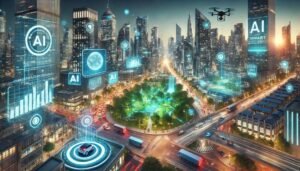
In an increasingly urbanized environment, AI traffic management has emerged as a significant
challenge. Data from the World Bank indicates that 56% of the global population currently
inhabits urban areas, a number projected to escalate to 70% by 2050. This swift urbanization is
directly associated with rising traffic congestion and its related issues, impacting millions of
individuals daily.
Effective traffic management is essential not only for minimizing travel times but also for
facilitating the seamless movement of individuals and goods within urban settings. Traditional
approaches, however, often face difficulties in delivering the real-time responsiveness necessary
in our fast-paced, contemporary cities. This is precisely where Artificial Intelligence (AI) becomes
a transformative influence in transportation management.
AI is revolutionizing the strategies employed by authorities in traffic regulation, presenting
dynamic solutions that adapt to the constantly evolving urban environment. The potential
implications are so profound that, according to Juniper Research, global investments in
intelligent traffic management systems are anticipated to reach $277 billion by 2025.
This article investigates the role of AI in traffic management, delving into its various applications,
potential advantages, and challenges. It will also highlight several cities that are effectively
implementing AI-enhanced traffic management systems, exemplifying real-world instances of
this groundbreaking technology.
How AI is Revolutionizing Traffic Management
AI is reshaping traffic management through sophisticated methodologies such as computer
vision, machine learning (ML), and deep learning (DL). This is augmented by the deployment of
sensors and cameras for data acquisition. Algorithms process the data, generating insights that
inform decision-making.
Here are some prominent ways AI is transforming traffic management:
Real-time insights and predictive analytics
Intelligent Traffic Systems (ITS) strive to improve traffic management by making commuting
times more predictable and less burdensome. Such systems can analyze real-time traffic camera
feeds to identify non-linear traffic bottlenecks or vehicles breaching traffic regulations.
The system can also capture more detailed metrics, such as vehicle speed and density. An
adaptive traffic signal control mechanism can utilize these data points to monitor and adjust
traffic signals, particularly at crossings. AI dynamically modifies signal timings based on real-time
information gathered from the roadway, thereby minimizing wait times and alleviating
congestion at intersections.
This AI-driven real-time monitoring can assist in detecting an irregular influx of vehicles and
extend the green signal for a specific direction. Moreover, authorities can redirect traffic and
provide real-time traffic advisories.
ITS has also proven instrumental in traffic law enforcement, aiding in the identification of
violations. Algorithms can automatically detect vehicles running red lights and other infractions,
such as lane changes.
AI-powered predictive analytics in traffic management employs a diverse range of data sources,
including historical traffic trends and meteorological information. Advanced algorithms,
particularly artificial neural networks (ANNs), excel at analyzing these intricate datasets to unveil
patterns and correlations, thus enabling precise traffic condition forecasts.
Additionally, algorithms such as support vector machines (SVM) and deep belief networks are
utilized to evaluate the impact of external factors, such as weather conditions, on traffic flow. By
leveraging these advanced algorithms, AI-driven predictive tools empower traffic controllers to
foresee traffic patterns under various scenarios.
AI-driven air traffic administration
Air navigation service providers are progressively incorporating artificial intelligence into air
traffic administration (ATM), partially influenced by ongoing staffing deficiencies. The capacity of
AI to evaluate and process the vast datasets generated by repetitive operations in air traffic
control (ATC) renders it an essential resource in this sector.
In a discussion with Avionics
International, Blake Cushnie, the program director of service delivery at NAV Canada,
underscored AI’s promise to transition the industry from reactive to proactive planning
methodologies.
Outlined below are critical areas where AI is exerting notable effects in ATM:
Forecasting and mitigating congestion: Air traffic controllers utilize flight plan information to
assess air traffic congestion. However, this approach can be inconsistent, as aircraft may alter
their flight trajectories significantly. Consequently, traffic hotspots may emerge, providing
limited time for air traffic controllers to respond.
AI-driven tools can predict and address air traffic congestion through advanced predictive
capabilities. For example, the European Union’s initiative ASTRA employs similar functionalities,
with the union aiming to substantially diminish delays and emissions.
Meteorological forecasting: Inclement weather is a leading factor contributing to flight delays,
which adversely affect passengers, airports, and airlines. According to an IATA report, the
economic impact of these delays is estimated at $30 billion each year
Utilizing neural networks, deep learning algorithms can create predictive models to identify
weather conditions impacting aviation, such as turbulence and reduced visibility. These
solutions enhance operational efficiency by providing air traffic controllers with crucial
information regarding sectors likely to be influenced by convective weather.
The EU is also evaluating an initiative known as ISOBAR, which employs convective prediction to
assist operators in their decision-making processes. This solution is expected to offer additional
advantages, including improved predictions of thunderstorms and minimized network delays.
London’s Heathrow Airport is piloting an AI-based framework to improve safety and diminish
light delays caused by adverse weather conditions. The initiative aims to recover approximately
20% of lost capacity due to disruptions arising from cloud cover and limited visibility.
Voice assistance: Automatic speech recognition technology can alleviate the manual workload
for air traffic controllers. This technology extracts pertinent information from ATC-pilot
communications, thereby enabling controllers to concentrate on other essential responsibilities.
A comparable solution has been implemented for the Prague approach, resulting in a reduction
in command recognition errors from 7.9% to 0.6%.
Integration with IoT Sensors and Connected Vehicles
AI possesses the ability to evaluate data from V2X systems to foresee traffic incidents, such as
sudden alterations in traffic patterns, enabling drivers to respond proactively. Furthermore, AI
enhanced V2X facilitates dynamic routing based on accidents or traffic congestion. As this
technology advances, vehicles are expected to execute platooning and automated lane changes,
thereby enhancing traffic flow.
Smart Traffic Control Systems
Adaptive traffic signal control (ATSC) systems utilize AI to improve traffic management. In
contrast to traditional static timing traffic controls, ATSC adjusts signals dynamically based on
real-time traffic conditions. These systems employ advanced methodologies such as deep
reinforcement learning, particularly deep Q-learning, to continually enhance their accuracy and
efficiency.
AI-driven solutions also play a vital role in forecasting crash risks at intersections. Machine
learning (ML) models can evaluate potential hazards by analyzing traffic volume, intersection
layout, and driving behaviors. When trained with data from various intersections, they can
assess crash risks across multiple junctions. The integration of computer vision techniques
further augments these solutions, assisting in minimizing incidents involving pedestrians and
cyclists at intersections.
Moreover, AI-assisted ATSC significantly elevates incident management. For instance, Iteris, a
company specializing in intelligent mobility infrastructure management, has created an
advanced platform that processes more than 150 data points. Their AI system employs
sophisticated algorithms and natural language processing (NLP) to accurately convert incident
descriptions into standardized event codes, thereby streamlining the response process.
Benefits of AI-Powered Traffic Management
The application of AI in traffic management has the potential to fundamentally transform travel
experiences.
Let us highlight several advantages of employing AI for traffic management.
Reduced Congestion: AI can drive a variety of traffic management solutions, ranging from
adaptive control systems to decision-support tools. By harnessing data from diverse sources, AI
can assist in optimizing traffic flow through real-time insights and predictive capabilities.
Increased Safety for Drivers, Pedestrians, and Cyclists: Technologies such as AI-based V2X can
provide collision avoidance strategies and early warning systems that may mitigate traffic
incidents. AI can also be deployed at road intersections to monitor areas susceptible to
accidents or hazardous conditions. Furthermore, authorities can utilize AI for the real-time
observation of unsafe road behaviors and the effective implementation of deterrent measures.
Lower Emissions and Environmental Impact: Vehicles in traffic significantly contribute to global
emissions, thereby harming the environment. According to the U. S. Environmental Protection
Agency, the average passenger vehicle emits 4.6 metric tons of carbon dioxide annually. The
deployment of AI-driven traffic management solutions reduces time spent in traffic through
dynamic routing and adaptive signaling, which directly lowers emissions.
Enhanced Urban Livability and Economic Productivity: Traffic congestion incurs considerable
costs and adversely affects economic productivity and urban livability. AI enhances the
transportation of people, goods, and services by resolving bottlenecks within traditional traffic
systems.
Challenges of AI-Assisted Traffic Management
In spite of the various benefits that artificial intelligence offers for traffic management, several
obstacles impede its widespread implementation. Beyond the intricacies of projects and
elevated costs of execution, additional challenges comprise:
Data confidentiality and security: AI systems depend on information gathered from numerous
sources, often including personal data. The sensitive character of this information necessitates
stringent safeguards against unauthorized access.
AI-enhanced traffic solutions also have an extensive security vulnerability due to the integration
of diverse technologies and devices. These systems must be fortified with comprehensive
security measures and trained personnel to avert manipulation, which could lead to data
breaches or harmful incidents.
Ethical dilemmas: AI systems frequently face examination, primarily because of trust and
transparency concerns. Moreover, algorithmic bias may result in inequitable outcomes. To
address this issue, algorithms need to utilize representative data to guarantee equity.
Infrastructure obstacles: Mismatched and antiquated traffic management systems pose
challenges to the deployment of AI-driven solutions. Upgrades may incur additional expenses
and result in intricate implementations.
Case Studies and Success Narratives
Numerous urban centers have adopted AI-fueled traffic management solutions. Below are
several illustrations:
Singapore: The city-state employs an intelligent transportation system (ITS) to anticipate traffic,
assist public transit schedules, and manage road congestion. Additionally, the city provides
traffic insights to commercial transportation firms, aiding in alleviating congestion.
London, UK: Transport for London (TfL) has established an ITS throughout the city. It performs
various functions, including traffic oversight. The system utilizes AI for adaptive traffic signal
modifications, easing congestion based on real-time data.
Lisbon, Portugal: The city collaborated with Siemens to implement AI-driven traffic
management solutions at 260 intersections to mitigate peak-hour traffic. Travel durations were
enhanced by 20% to 70%, while the frequency of stops at red lights diminished by 30%.
Conclusion
The swift increase in human and vehicle populations has resulted in unprecedented traffic
congestion across numerous urban centers, profoundly affecting social dynamics and economic
efficiency. Nevertheless, AI is emerging as a formidable solution to these challenges. Its ability
to analyze extensive volumes of real-time data, forecast traffic trends, and facilitate well
informed decision-making is paving the way for safer and more sustainable transportation
frameworks.
Cities such as Lisbon and London have already harnessed AI with noteworthy outcomes. For
example, both cities have witnessed significant enhancements in their traffic flow. Beyond mere
monitoring of existing traffic conditions, AI has proven its efficacy in predicting traffic patterns,
augmenting the functionality of connected vehicles, and even optimizing air traffic
management. These applications illustrate AI’s adaptability and potential to transform urban
mobility across multiple dimensions.
2 thoughts on “How AI Traffic Management Is Transforming Smart Cities”