

1. Introduction to Ocean Exploration Robots
The ocean still scares me. I’ll admit it. Even standing at the shore, when a wave pulls the sand out from under my feet, I feel that reminder: there’s a whole other world down there, one that doesn’t really care about us. And yet, we’ve always been curious —Ocean Exploration Robots humans just can’t help poking at mysteries.
Now, most of us can’t scuba dive 11,000 meters into the Mariana Trench (our lungs would turn to jelly, not a great look). So we built helpers: ocean exploration robots. They’re like stand-ins, little mechanical bodies that go down into crushing pressure, freezing cold, pitch darkness… and come back with stories, data, and sometimes even photos of creatures that look like nightmares from a sci-fi movie.
2. Definition and Overview
At the simplest level, Ocean Exploration Robots these robots are machines designed to explore underwater places we can’t reach. Some are remote-controlled with long cables stretching back to ships; others are set free to roam on their own, collecting info and coming back later with a “digital diary” of what they saw.
They’re not all shiny Hollywood-style robots either. Some are clunky boxes with cameras bolted on. Others look like torpedoes, or even like snakes that slither through cracks in shipwrecks. But together they serve one purpose: to extend our reach under the sea.
3. Historical Context and Evolution
Funny thing: ocean robots sound modern, but the dream is ancient.
The Greeks were already playing with diving bells thousands of years ago.
Fast forward to the 1930s, and you’ve got scientists dangling bathyspheres — basically steel balls with windows — on cables into the deep. Brave souls climbed inside, which to me sounds like volunteering for a coffin.
In 1960, the Trieste submarine actually reached the bottom of the Mariana Trench. A manned craft! That’s mind-blowing.
By the 1980s, robots like Jason Jr. were exploring the Titanic wreck, giving us haunting images of plates and chandeliers lying silent at the bottom of the ocean.
Today? Sleek, AI-driven vehicles map the seafloor in 3D, sniff for chemicals, even grab samples. The jump from “rope and steel ball” to “autonomous glider” happened in less than a century.
4. How Ocean Exploration Robots Work
Here’s the part I find cool — and a little overwhelming.
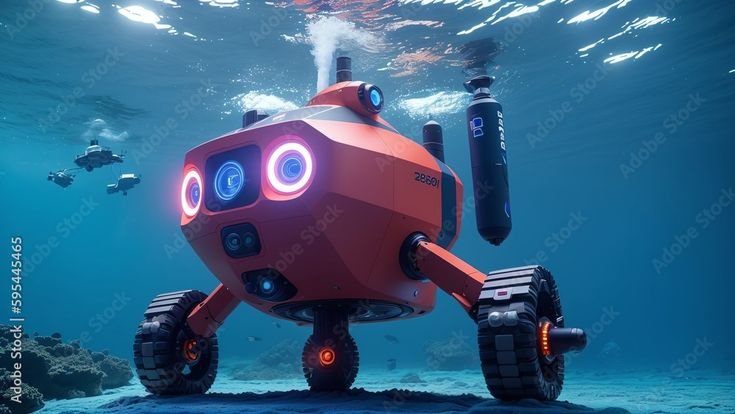
ROVs (Remotely Operated Vehicles): Think of them like puppets. A ship sends power and commands through a cable, and the robot obeys, sending back video in real time.
AUVs (Autonomous Underwater Vehicles): These are more like free thinkers. You load a program, set them loose, and they figure out their path, eventually surfacing to upload data.
Sonar & Sensors: Since light barely penetrates deep water, sound is the main tool. Sonar “pings” bounce off surfaces and create maps. Robots also carry temperature, pressure, and chemical sensors.
Cameras & Arms: High-definition cameras give us eerie footage; mechanical arms let robots “grab” corals, clams, or even artifacts.
Training is odd. Engineers test robots in swimming pools, lakes, or shallow bays. They tweak endlessly, because one little software hiccup at 4,000 meters deep means goodbye robot (and millions of dollars).
5. Types of Ocean Exploration Robots
I won’t make this too neat of a list, but roughly speaking, you’ve got:
Tethered ROVs — safe but limited by cable length.
Free-roaming AUVs — independent but riskier.
Long-term gliders — moving with currents for months.
Snake-like or bio-mimic robots — newer, experimental, inspired by marine life.
Each type has its “sweet spot.” You don’t send a tethered ROV across the whole Pacific, just like you wouldn’t expect a glider to dig around a shipwreck.
6. Applications
This is where things get exciting: Ocean Exploration Robots
Scientists use them to measure currents and temperatures that help us predict climate change.
Marine biologists ride along virtually, discovering bizarre animals: translucent fish, crabs living in boiling vents, glowing jelly creatures.
Archaeologists explore shipwrecks — from the Titanic to ancient trading vessels — without risking human divers.
Even industries rely on them: oil companies, cable repair crews, and governments searching for missing airplanes.
Every application is a mix of curiosity and practicality. Sometimes it’s about saving lives, sometimes about making money, sometimes just satisfying our endless “what’s down there?” itch.
7. Benefits and Challenges
Advantages of Ocean Exploration Robots :
They go deeper than we ever could.
keep humans safe.
They can run for hours, even days, without stopping.
Challenges (and they’re big ones):
These machines are insanely expensive. A single unit can cost millions.
The ocean eats robots for breakfast — corrosion, crushing pressure, unpredictable currents.
Communication is tricky; no GPS or WiFi works underwater.
Ocean Exploration Robots And of course, the heartbreak: sometimes a robot just… disappears. Imagine waiting for your expensive explorer to surface, only for silence.
8. Ethical Considerations
This part makes me pause. Yes, robots help us, but:
If companies start mining the seafloor with fleets of robots, are we destroying ecosystems before we even understand them?
Do we risk scaring off fragile deep-sea life with our machines’ lights and sounds?
And who owns the “treasures” found? Is data about the ocean a global right, or just for whoever paid for the robot?
The ocean belongs to all of us. Robots make it reachable, but that doesn’t mean we should plunder it blindly.
9. Popular Tools and How They Work
Some names keep popping up in ocean stories:
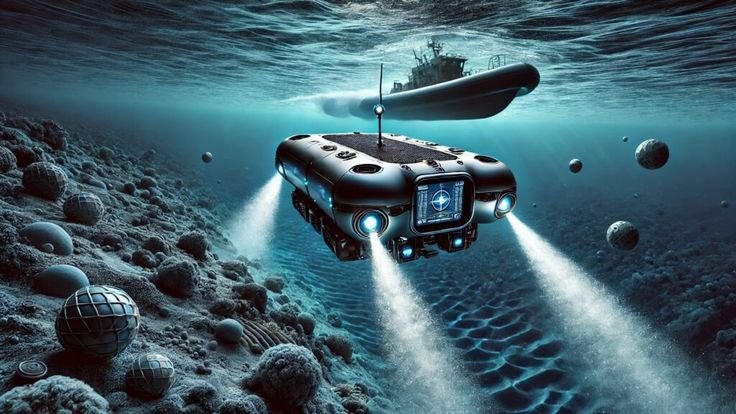
Jason ROV — helped explore the Titanic.
Nereus — an ambitious robot that reached deep trenches before being lost to pressure.
Seagliders — slow but persistent, mapping climate data across oceans.
Eelume Snake Robot — looks creepy, slithers like a sea snake, but can inspect pipelines and cracks.
They’re not “household names,” but in the marine science world, these are celebrities.
10. Future Trends
I’ll be honest: the future both excites me and gives me chills.
Swarms of small robots could one day explore the ocean like schools of fish.
AI will make them smarter, able to adapt instantly when something unexpected happens.
Some companies are already eyeing fleets of mining robots (controversial!).
And maybe — wild thought — we’ll one day have underwater colonies, with robots laying foundations long before humans move in.
11. Case Studies and Success Stories
Stories make this real:
1985: The Titanic wreck revealed by ROVs — iconic, heartbreaking, unforgettable.
2010: After the Deepwater Horizon oil spill, ROVs were the first responders, helping cap the leak.
2014: In the hunt for flight MH370, robots mapped thousands of square kilometers of seafloor.
Coral reef studies: AUVs documenting bleaching in the Great Barrier Reef, showing us how urgent conservation is.
These aren’t just gadgets — they’re lifelines for science and history.
12. Conclusion and Key Takeaways
So where does this leave us? For me, ocean robots are like the perfect symbol of human curiosity. We can’t help ourselves — we build machines to go where our bodies fail. And the ocean, mysterious and merciless, keeps drawing us in.
Key thoughts:
Robots are essential for science, safety, and sometimes even survival.
They open doors to wonders but also raise tough ethical questions.
The ocean is fragile — exploration must come with responsibility.
The truth is, every robot that dives beneath the surface carries our collective curiosity with it. And every blurry photo of a new creature reminds us: Earth still has unexplored worlds.
13. Frequently Asked Questions (FAQ)
Q1: Can ocean robots reach the very bottom of the sea?
Yes, some have reached the Mariana Trench, though many don’t survive the attempt.
Q2: Do they find new animals often?
All the time. Many deep-sea creatures have only been seen because of robot cameras.
Q3: Are they used only for science?
No, industries use them for oil, gas, cables, and even military tasks.
Q4: Are they affordable for small research groups?
Not really — though smaller, cheaper models are slowly emerging.
Q5: What’s the biggest risk?
Losing a robot to the ocean’s pressure, currents, or malfunctions.